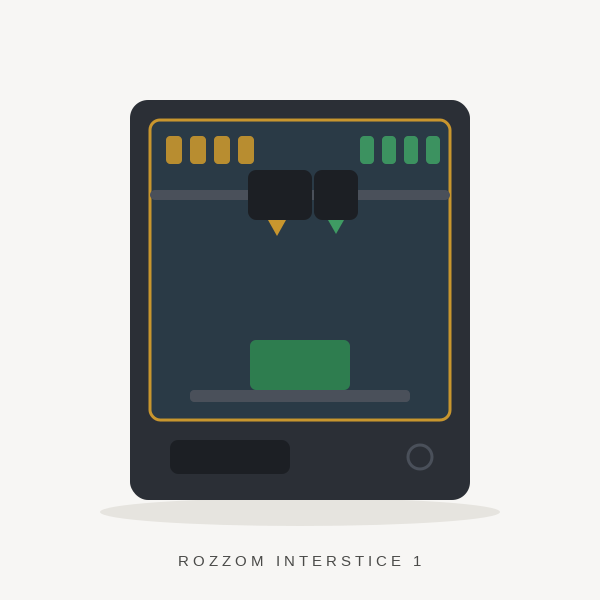
Rozzom Interstice 1 and Interstice 1 Pro
Two enclosed multi-material 3D printers with a large build volume: one with two nozzles and automatic hot-end swapping, one with a full tool changer.
- Interstice 1: two nozzles side by side; one of the two positions also swaps its whole hot end automatically
- Interstice 1 Pro: a full tool changer that docks and picks up complete print heads, each with its own extruder, hot end and filament path
- Build volume: about 356 × 356 × 406 mm (14 × 14 × 16 in) on both models
- Enclosed: the print area is inside a closed chamber
- Rozzom Printer OS: including speed adaptive mode (more about the OS)
- Rozzom expansion bus: for Rozzom Meteor filament feeding and drying units
Models
| Item | Interstice 1 | Interstice 1 Pro |
|---|---|---|
| How it changes material | Dual nozzle: two nozzles side by side. One position swaps its whole hot end (nozzle and heater together) automatically from a set stored inside the printer | Full tool changer: several complete print heads are parked in docks; the printer picks up the one it needs |
| Extruders | Servo-driven extruders for the two nozzle positions | Each print head has its own servo-driven extruder, hot end and filament path |
| Build volume | About 356 × 356 × 406 mm (14 × 14 × 16 in) | About 356 × 356 × 406 mm (14 × 14 × 16 in) |
| Swapping | Left nozzle fixed; the right nozzle position swaps hot ends | Any of the print heads can be picked up |
| Stored hot ends / print heads | 8 hot ends in two racks of 4 | 10 print heads |
| Material change time (target) | Under 20 seconds | About 6 seconds or less |
| Hot end temperature | Up to 375 °C; optional high-temperature hot end up to 450 °C | Up to 375 °C; optional high-temperature print head up to 450 °C |
| Bed temperature | Up to 120 °C | Up to 150 °C |
| Heated chamber | Up to 65 °C | Up to 90 °C |
| Power | Normal printing within a standard US 120 V, 15 A outlet (1,440 W continuous). High-temperature mode (450 °C hot end and hottest chamber) needs a 20 A 120 V or a 230 V circuit. | |
Shared features
| Frame | Enclosed chamber |
|---|---|
| Software | Rozzom Printer OS, with speed adaptive mode |
| Cameras | Frame camera and toolhead camera |
| Lights | Headlight for the print area and a toolhead light |
| Filament sensors | Yes |
| Filtration | H13 HEPA and activated carbon |
| Hot end and tool ID | Each swapped hot end and print head carries an RFID tag that tells the printer what it is and passes on its temperature readings |
| Extruder | High-quality servo-driven extruder(s) |
| Lidar | Optional |
| Expansion port | Rozzom expansion bus, for Rozzom Meteor filament units |
Why two ways to change material?
Different jobs need different nozzles and materials. A small nozzle prints fine detail, a large one prints big parts quickly, and some filaments need a tougher nozzle. The Interstice 1 keeps a set of complete hot ends inside the printer and swaps them on one of its two nozzle positions, so each hot end keeps its own heater and nozzle and can stay with one filament to reduce purging. The Interstice 1 Pro goes further: every print head is complete, with its own extruder and filament already loaded, so changing material is a matter of parking one head and picking up the next.
What makes it better: our goals
Filament for the Interstice 1 Pro
The tool changer has a separate filament path for each print head, so it uses its own 8-color unit, the Meteor 1H.
These are design goals and proposed targets. None of them has been built or tested yet, and they may change.
- Larger build volume: about 356 × 356 × 406 mm (14 × 14 × 16 in), decided. Goal: every nozzle and print head can reach the whole volume.
- Faster material changes: the next hot end or print head is prepared while the current one prints. Proposed target: under 20 seconds per change on the Interstice 1 and about 6 seconds on the Interstice 1 Pro, measured from print to print including priming.
- More materials without purging: proposed target of more stored hot ends and print heads than typical machines in this class, so more jobs print with no purge waste at all.
- Engineering materials: goal of an optional high-temperature hot end, a hotter bed and an actively heated chamber for demanding plastics. Targets are in the table above.
- Wireless power for swapped parts: the Interstice 1's swapped hot ends and the Interstice 1 Pro's print heads are heated by induction, so there are no electrical contacts at the coupling to wear out or get dirty.
- Automatic alignment after every swap: goal of the printer checking each nozzle's position by itself after a hot-end or tool change, so colors and materials line up without manual calibration.
- Drying for every filament: goal of every slot in a Meteor Pro unit being able to dry its filament, not only some of them.
- Cleaner air: goal of a HEPA and activated-carbon filter inside the chamber, with Printer OS tracking filter life.
- Watches its own prints: goal of the cameras spotting failed prints and checking the first layer on the printer itself, without needing the internet.
- Works on a normal wall outlet: goal of Printer OS managing power so the printer runs on a standard household circuit, with a high-temperature mode for a stronger circuit.
- Easy to service: goal of user-replaceable hot ends and print heads, documented commands and local-only operation.
Rozzom Printer OS and Meteor
Both models run Rozzom Printer OS. Its speed adaptive mode slows down on hard parts of a print and speeds up on easier ones. The OS also keeps track of which hot end or print head is where and which filament each one last used. The cameras, lights and sensors on the printer feed into the OS. Both models have the Rozzom expansion bus port, so a Rozzom Meteor filament feeding and drying unit can connect to them.
Not decided yet
- Print speed
- Noise level (to be measured on prototypes)
- Outer size and weight
- Price and release date
Rozzom Interstice 1 and Interstice 1 Pro are in development. Specifications are targets and may change. Goals and targets listed above are not tested results.