Rozzom Element
A laptop built around Rozzom's own processor and graphics chip, sharing one pool of fast GDDR7 memory.
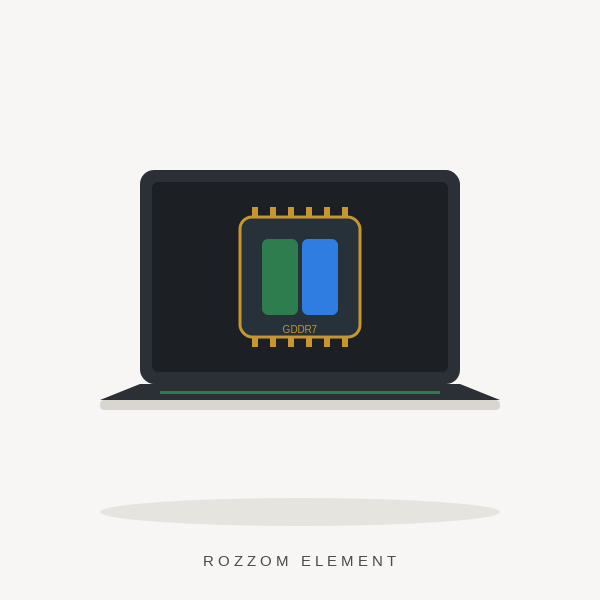
- Processor (CPU): designed by Rozzom. Rozzom CPU: design started (name to be chosen). Cores and clock speeds: not decided yet.
- Graphics (GPU): designed by Rozzom. Rozzom GPU: design started (name to be chosen). Size and speed: not decided yet.
- Memory: unified GDDR7, shared by the CPU and the GPU. Amount: not decided yet.
- Storage: not decided yet.
- Display: not decided yet.
- Battery: not decided yet.
- Operating system: not decided yet.
- Price: not decided yet.
Availability: Release date unknown. The chips are at the very start of their design; nothing has been built yet.
What is unified memory?
Most laptops with a separate graphics card have two kinds of memory: system RAM for the processor, and video memory (VRAM) on the graphics chip. Data that both need is copied back and forth between them. With unified memory, the processor and the graphics chip share one pool of memory. There is nothing to copy, and the graphics chip can use as much of the pool as the task needs.
This is not a new idea. The PlayStation 5 uses one 16 GB pool of GDDR6 memory at 448 GB/s for both its processor and graphics (PlayStation Blog), and the Xbox Series X does the same with 16 GB of GDDR6 (Xbox). In laptops, Apple silicon and the AMD Ryzen AI Max chips use unified memory too, but with LPDDR5X, a lower-power memory (AMD).
Why GDDR7?
GDDR7 is the newest graphics memory standard (JEDEC JESD239, published March 2024). It sends three signal levels instead of two (called PAM3), so it moves more data per clock than GDDR6 (JEDEC). Memory makers ship it at 32 Gb/s per pin and faster, and say it is more power-efficient than GDDR6 (Micron, Samsung).
High memory bandwidth is what graphics and AI need most: games read large textures every frame, and running AI models is mostly limited by how fast memory can be read. Using GDDR7 as the only memory gives the whole laptop graphics-card bandwidth.
The trade-offs
- Slower response for the processor: graphics memory is built for bandwidth, not quick response (latency). When AMD sold PlayStation 5 chips as a desktop kit, reviewers measured about twice the memory latency of normal DDR4 and weaker single-thread performance (Tom's Hardware). The Rozzom CPU will need large caches to make up for it.
- Less total memory: today's GDDR7 chips hold 2 GB or 3 GB each (Samsung), so a laptop has far less room than LPDDR5X designs, which reach 128 GB.
- Power and heat: graphics memory is made for desktop and gaming-laptop graphics cards, not for long battery life, and it needs cooling. Expect the Element to be a performance laptop, not an ultra-thin one.
- Not upgradeable: GDDR7 is soldered next to the chip, so the memory amount is fixed when you buy it.
- Unusual: we have not found a laptop on sale that uses GDDR memory as unified memory for both processor and graphics. That is what makes the Element different, and it is also the main risk.
Rozzom CPU: design started Rozzom GPU: design started
Rozzom Element is in development. Nothing has been built yet; everything not listed above is not decided yet. Specifications are targets and may change.